

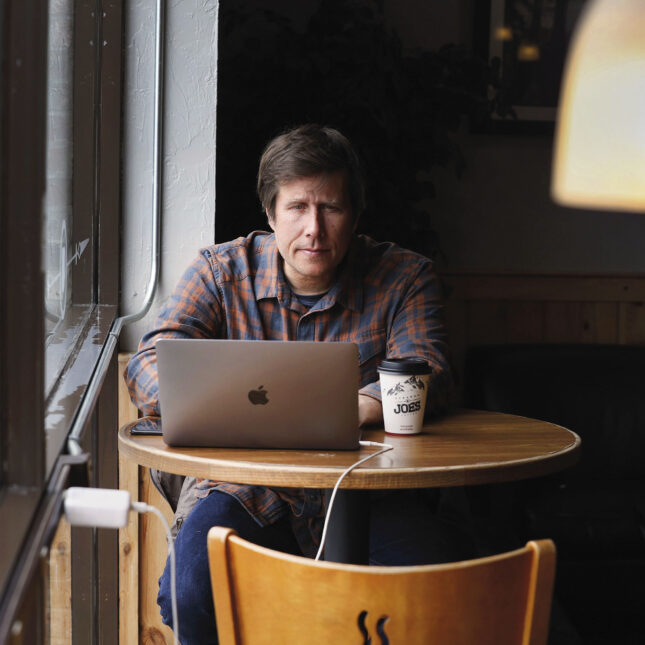

Every year, the Genetics Society of America bestows the Elizabeth W. Jones Award for Excellence in Education, recognizing someone who has helped the public better understand the science of DNA. It’s understood to be a lifetime achievement award; past recipients tend toward retirement age with decades of work behind them and stacks of textbooks to their names.
When this year’s winner, Brian Donovan, was announced at the end of February, many geneticists and science educators found it hard to celebrate the news. Not because he’s undeserving of the honor. Far from it. But because it seemed to confirm what many feared: that Donovan’s incandescent research career was over before it had barely begun.
In less than a decade, Donovan had done something remarkable. With hard-fought evidence gathered from inside American classrooms, he had mobilized a coalition of high school science teachers, education researchers, and geneticists to accept that prejudice might be a solvable problem.
Straight out of a Ph.D. program at Stanford, Donovan had gathered a team around him to develop a new approach to high school genetics education — one that moved beyond Mendel’s peas and Punnet squares to emphasize the true complexities of human genetic variation. They’d been training teachers on the curriculum and had secured funding from the National Science Foundation to test it in middle and high schools. They wanted to know if grounding kids in a more accurate understanding of how genes and the environment interact to create differences between people could make them less susceptible to scientifically unsupported beliefs in biological essentialism — the basis for racial prejudice.
It was a daunting challenge, the kind of work that requires balancing tight control of classroom conditions — so you can draw inferences about the effects of the instruction — with a need to keep things realistic enough that teachers could actually pull off the curriculum in the real world. And you have to do it at scale, meaning getting buy-in from school districts, teachers, students, and their parents. Education researchers told STAT such experiments are exceedingly rare owing to their design complexity and logistical nightmarishness.
And that’s before a global pandemic emerged that would shut down schools, and the murder of George Floyd in Minneapolis, which would spark a racial reckoning across America and place the teaching of race center stage in national presidential politics. Through all that, Donovan’s team slowly and painstakingly conducted a series of randomized experiments. And when the first clear signals came in, showing that yes, genetics education can indeed reduce racism, Science published the results in February 2024.
“His studies were stunningly impressive,” Jon Shemwell, a science education professor at the University of Alabama, said of Donovan. “This guy is a generational talent.”
Colleagues and collaborators had hoped Donovan would become the standard-bearer for the future of education research, someone who could lead the field in a more quantitative direction with the courage to march those methods across the political minefield of genomics, race, gender, and sex. And though Donovan is quick to apportion credit for any successes elsewhere, once upon a time, that’s what he envisioned for himself too.
“What I really wanted was to take a sledgehammer to prejudice,” Donovan said. “I was naive enough to think that we could teach genetics and actually make a real dent in this problem.”
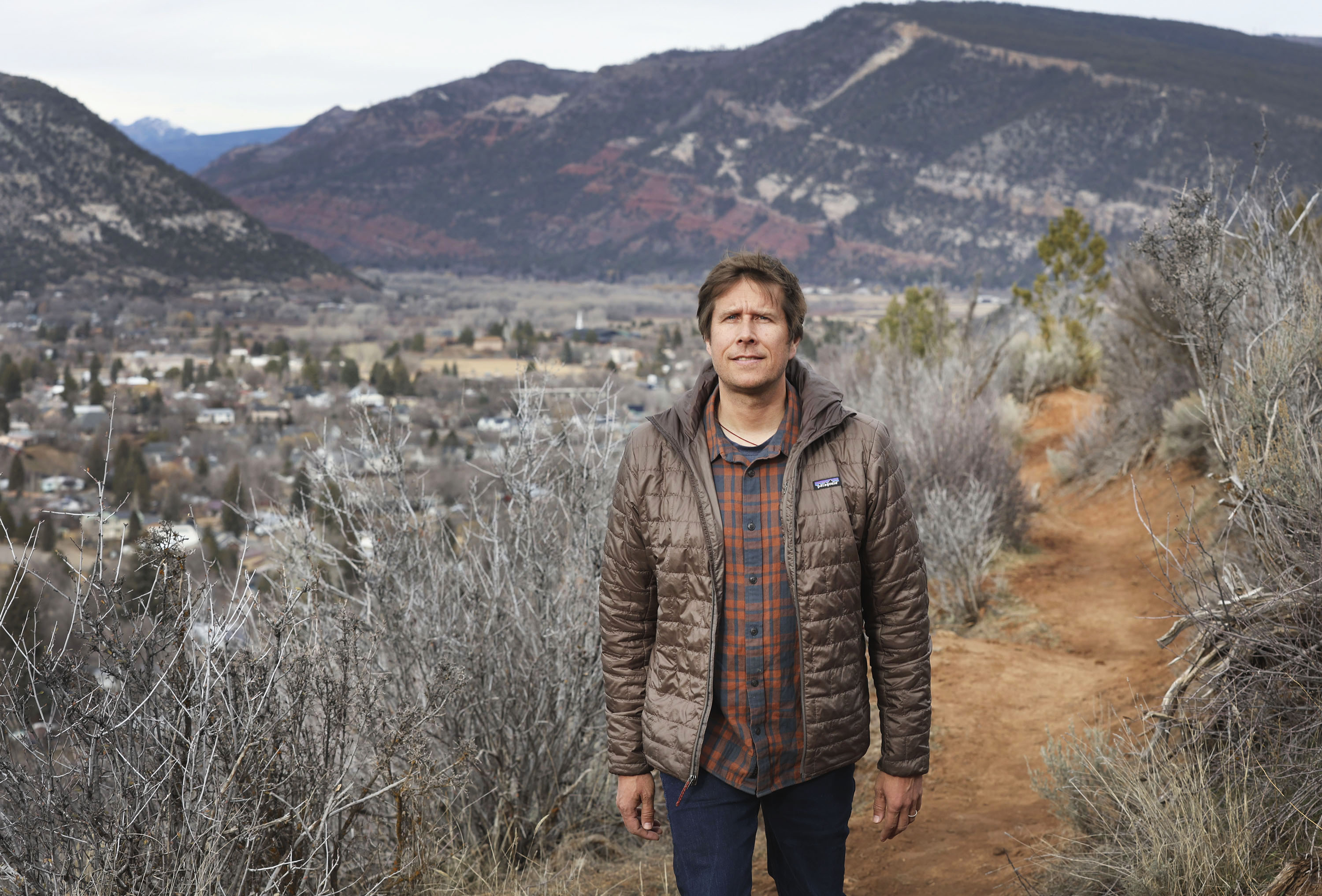
He spoke to STAT from his home in rural Colorado, where for the last year he has been trying to process the abrupt end — not just of his career as a scientist, but of a personal crusade he embarked on two decades ago to help kids become fluent in the facts of human DNA. And in the process, to maybe, finally, find a way to inoculate future generations of Americans against the kinds of genetic misinformation that has been fueling white supremacist belief systems for centuries.
On a single day last April, both of Donovan’s National Science Foundation grants were terminated — part of a mass cancellation of science education awards the agency had determined to “no longer effectuate administration priorities.” While his tenured collaborators would scrounge some funds to keep pieces of the projects afloat, for Donovan, no grants meant no salaries for him and his small team at the University of Colorado. By the end of the summer they found themselves unemployed.
Some of the work they started will go on — more slowly, and at a much smaller scale. But Donovan won’t be a part of it. Recently, he started taking classes and preparing to apply to nursing school. It’s a decision he reached after many painful months of coming to terms with the fact that in the current political climate, his resume is more of a liability than evidence of future promise. “My work was threading a tiny needle on one of the most controversial issues in America,” Donovan said.
For close to 15 years, he’d been fighting to keep it going, to protect it within an institution, to bring other people in and move it beyond him. Now he had to hope they could carry on his work.
“He’s a very tough loss for this field,” said Andrei Cimpian, a cognitive development researcher at New York University and a former collaborator of Donovan’s. He and others describe Donovan as a brilliant statistician with a dizzying array of expertise into how humans differ and how the human mind navigates the complex social dynamics that emerge from those differences. “One of the reasons he was so successful is he was so conversant with these various literatures and could distill them into ways of talking about race and gender that was legible to high school kids while still being true to the scientific nuance,” Cimpian said. “It’s a unique set of skills I’ve not encountered in one person before.”
The NSF declined to comment.
In many ways, Donovan’s story is distressingly familiar. At the NSF, grants for science education research have taken the hardest hit under the Trump administration, accounting for 48% of all terminations at the agency and 65% of the total funding cut, according to a list of terminated awards released last summer.
And like Donovan, a significant portion of the scientific workforce conducts research from “soft money” positions, where they are wholly dependent on grants that have to be renewed every few years. Despite their inherent precarity, such arrangements have become more common over the past eight decades, encouraged by universities looking to expand research capacity without the financial risks of long-term salary obligations and sustained by the federal government’s strong track record of honoring its commitments. When that compact was broken last year by the administration’s unprecedented purge of support for thousands of research projects, scientists in soft money positions were the first to feel the fallout.
But in other, important ways, the story of how Donovan wound up here is unique. It’s a story with useful lessons to offer about the history of genetics education in the U.S. and the growing divide between how much universities say they value interdisciplinary research and how poorly their internal structures are set up to reward it. What made Donovan a singular talent also made it easier for him to fall between the cracks. And down there he became far more vulnerable to the whims of federal science agencies increasingly under political capture.
Molded by Polish jokes and public humiliation
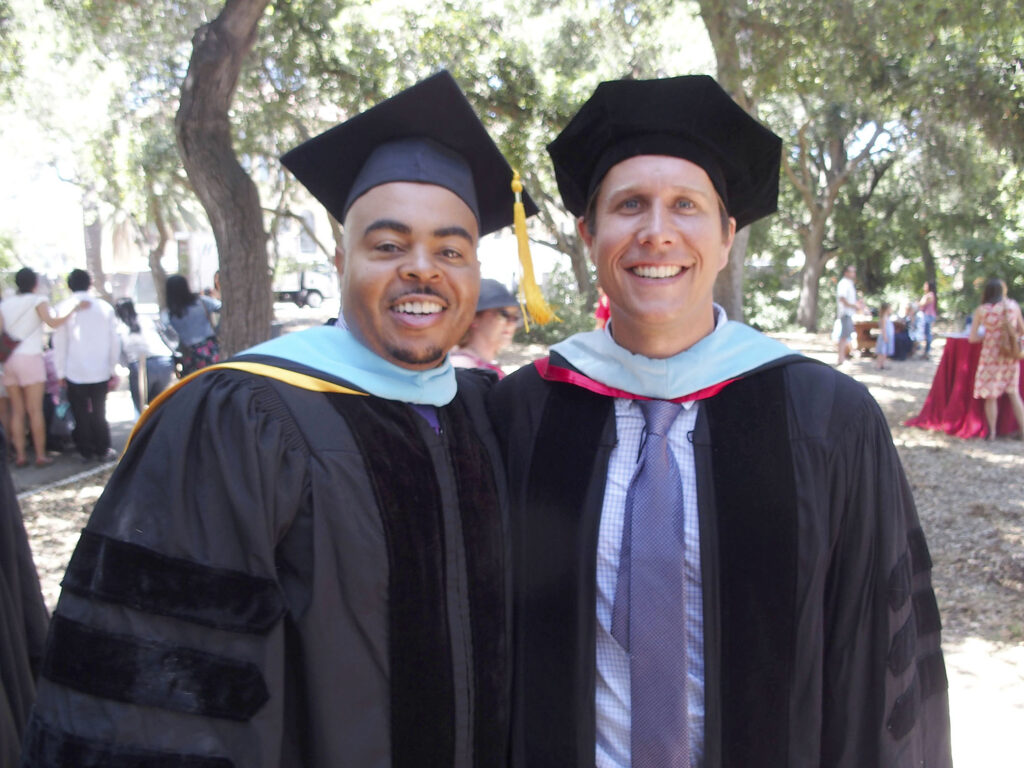
Donovan is tall with long limbs that move with the confidence of a lifetime spent scaling cliff faces. His sandy brown hair, perpetually wind-swept across his forehead, makes him appear younger than his 47 years. At home, he prefers technical tees and fleeces, but even when dressed in the academic uniform of a blue button-down and tie, he exudes the aura of an epistemic cowboy trapped in the body of a surfer dude. A devoted Buddhist, he meditates in silence each day, sometimes for hours. When he speaks, his words arrive in an urgent stream, intense yet exacting. He is almost unnervingly earnest.
After graduating from Colorado College in 2001 with a major in biology, he spent the next two years climbing around Utah and Colorado, and finding seasonal work with the U.S. Forest Service counting trees and tracking spotted owls. When asked by a local conservation group to help develop a field-based science curriculum, he discovered he wanted to be a teacher.
Donovan moved to San Francisco and got into a two-year teacher training program at one of the city’s most exclusive private schools. From there, he found a home teaching biology to seventh- and eighth-graders at the San Francisco School, a progressive, private institution in a more diverse neighborhood. As a first-time teacher at a school with many Black, Asian, Hispanic, Filipino, and Jewish students, he felt acutely aware of how intellectual stereotypes showed up in science classrooms. How they discouraged girls and students of color from seeing futures for themselves as doctors and software engineers and researchers. Since coming to the city he’d heard the way kids taunted each other in the halls and at recess, casually dropping sexist and racist jabs.
It reminded him of growing up in New Hampshire and hearing jokes on the bus about Polish people. Like “How do you stop a Polish tank? Shoot the soldiers pushing it.” As a kid, he’d laughed at these jokes, even told some himself. But as he got older and he learned more about his own family, they stopped being funny. His mother arrived on Ellis Island as a child with her parents, both ethnic Poles. His grandmother had spent World War II in a forced labor camp; his grandfather had fought in the Polish army before being captured and held as a POW. As a teenager, Donovan went back to Poland to visit his mother’s family, and spent a day at Auschwitz. Standing in the gas chambers, he thought about all the lives that had been stolen there, and the ideas about racial superiority that had been used to justify that theft.
“It really left a deep impact on my psyche,” he said. “Combined with what happened to my grandmother and my grandfather, it’s always been with me. On some level, I probably ended up doing the work that I did because I was subconsciously working that out.”
As part of the middle school curriculum, Donovan was responsible for introducing his students to genetics. He knew that most science educators in his shoes would stick to the basics: adenine pairs with thymine, cytosine pairs with guanine; DNA makes RNA, which makes proteins; dominant versus recessive alleles via Mendel’s peas. Questions about race and racial categories, which emerged as a social concept long before the field of genetics, are typically left to social studies teachers. But Donovan wanted to use the class to go beyond the basics, to kickstart his students’ understanding of human evolution — in part, to make sure they avoided making the same kind of mistakes he had.
As a college freshman, Donovan had suffered his first public humiliation at the hands of Stephen Jay Gould. The legendary biologist had come to campus while on a book tour for “The Mismeasure of Man” — his scientific critique of biological essentialism. This is the belief that social categories, like race or gender, are determined by an innate, biological “essence.” Such ideas were revived in the mid-1990s by the publication of “The Bell Curve,” which invoked the notion of innate differences in intelligence between racial groups in the U.S., using it to argue for the ending of welfare policies and other programs aimed at boosting opportunities for Black Americans, women, and other groups that have historically suffered discrimination. Gould had re-released his own book with new material refuting those arguments.
After the lecture, Gould took questions. In front of a few thousand students and faculty, Donovan, who had not yet read either book, stood up to ask the first one. As he recalls it, the question was something about the impact of ship-building technologies on how early human populations had evolved; if people hadn’t developed the ability to traverse the globe and exchange genetic material with other populations, would the human species have ever speciated? “It was like the dumbest question, just so uninformed by any kind of real understanding of biology,” Donovan said.
Gould dragged him, hard. For another person, having the flaws in one’s assumptions dissected before an audience of peers might have snuffed out any curiosity about human evolution. Donovan, though, doubled down, adding human biology courses to his schedule and becoming a fixture in the anthropology department.
Even so, trying to teach race and genetics to middle schoolers, he realized he was in way over his head. Rather than give up, he found his way to San Francisco University for a master’s in teaching and then to Stanford, for a Ph.D. in science education and another master’s, this one in biology.
He spent his dissertation investigating how the majority of American middle and high schoolers are taught genetics, and what kinds of beliefs those materials foster about race and biological essentialism. As he started to formulate ideas for a curriculum to replace them, he convinced a cadre of intellectually diverse academics to come on as mentors, including psychologists and philosophers of race, science educators, leading geneticists, and a dean of research.
One of those mentors was the pioneering psychologist Carol Dweck.
In the 1980s and ’90s, while at Columbia University, Dweck had gone into American classrooms to try to understand why certain children struggled with math. As she observed them, she started to realize the answer had nothing to do with those kids in particular, but with the pervasive belief that there are two kinds of people, those who are innately good at math and those who aren’t. That mindset, which teachers would sometimes unwittingly perpetuate, was keeping kids stuck. Dweck developed interventions to foster what she coined a “growth mindset” — the belief that excellence isn’t an innate trait, it’s something you can develop through dedication and effort — and tested them in schools.
Her work launched a whole new field of research, spawned industries in business coaching and sports psychology, and fundamentally changed how teachers treated students — embracing mistakes as learning opportunities and shifting from praising intelligence to rewarding perseverance. Donovan saw in Dweck’s career a blueprint he could follow: Conduct interventional studies of bigger and bigger size, generate compelling enough data that other groups would want to replicate it, and eventually, if all the data aligned, convince educational bodies to set new standards and pay for new teacher professional learning programs. It would take a long time, but that’s how to actually change things.
Rethinking the teaching of genetics
Monica Weindling still remembers the interview well. It was the summer of 2017, she was fresh out of undergrad and had applied for an entry level research job at a nonprofit organization called BSCS Science Learning, based in Colorado Springs. Founded in 1958 to reinvigorate the American science educational system in the post-Sputnik panic, BSCS is the main player in high school biology textbook publishing in the U.S. Donovan had landed there as a research scientist after Stanford and quickly secured a $1.3 million grant to further develop what he called the humane genomics literacy curriculum, teach it to teachers, and roll it out to students in a randomized trial. To do that he would need help.
One week before the interview with Weindling, Donovan sent her background reading on the project. It came to more than 100 pages. “It was very intense,” Weindling said. Over the years she saw him do the same thing with every potential new employee. She began to realize it wasn’t some kind of test, it was to ensure that people came in with eyes open and able to have an effective interview. “He’s always thinking about teaching and setting people up for success, even at the hiring level,” she said.
Weindling got the job and by October she was in San Francisco conducting “thinkalouds” with middle schoolers. She listened as they verbalized the first thoughts that came to mind as they read through the HGL materials.
The lessons are structured around two fictional teenagers, Robin and Taylor, who are trying to figure out how to interpret data from two real-world surveys. In one, the National Football League reported that 28% of its players in 2014 self-identified as white and 68% as Black. In the same year, the National Center for Education Statistics found that 75% of university professors in STEM fields identified as white and 6% as Black. Robin thinks the lopsided representation likely has something to do with genetic differences between people of different racial groups — specifically in genes for athletic or intellectual abilities. Taylor isn’t so sure. He thinks people have different genetic makeups but that those differences aren’t associated with race.
The truth is that Taylor is more right, but neither has a completely accurate view. It’s the students’ job to learn about the science of population genetics and multifactorial inheritance so they can interrogate the veracity of Taylor and Robin’s claims. That means learning that genetic differences emerged as early groups of humans expanded across the globe but that the variation between groups — in Africa versus Asia, for example — is much smaller than the variation that exists within each group.
This part of the curriculum drives home something Donovan often emphasizes in teacher training and speeches; that bias is best understood as a neurological process. It’s a coping mechanism humans evolved to make sense of living in an increasingly complex world. If we see a difference between how two people look on the outside, we might take a cognitive shortcut to erroneously conclude that’s because of something different about how they’re put together. It’s a way of framing things for students that’s blame-free, that invites curiosity both into the workings of our own minds and what science has to reveal about the world around us.
Students are also taught that unlike the seed coats on Mendel’s peas, most human traits aren’t driven by single genes. Common traits like height or blood pressure are influenced by variations at thousands of locations in the genome, each exerting a tiny effect. They’re also influenced by the physical — what you eat, where you live, what pollutants you’re exposed to — and social environments you inhabit.
Students are given data about how racism has produced profoundly different environments for Black and white Americans. And they learn about how these environmental variables often explain much more of the variation in people’s experiences. In one example, they read about a study of college football recruiters who had a history of rating Black high school athletes higher than their white counterparts. When asked to evaluate the athletes based on their stats alone, without knowing their race, that bias disappeared. A key part of the curriculum is conveying that genes aren’t the only thing people inherit.
“That was a big eye opener for me and I think for a lot of other teachers,” said Paul Strode, a high school biology teacher in Boulder, Colo., who was one of the first instructors to work with the HGL curriculum. “It’s a far cry from Punnet squares and other status quo materials that teach kids that things like eye color, nose shape, they’re all just coin flips. That cements this misconception that human traits are simple, and what Brian argues and what I agree with is it opens the door for making assumptions about people based on what they look like.”
As students work through the HGL curriculum, they’re not just learning about genetics, they’re also learning about how to reason with evidence. The fictional characters don’t just create a safe space for kids to think through their own misconceptions about genetic causes of racial inequality, they also model what it looks like to overcome science denial. “It’s more effective than me, as the authority, just telling them ‘here’s how it is,’” Strode said. “It’s them discovering how it is based on the science.”
When Strode and Donovan held a workshop on the materials at the annual meeting of the National Association of Biology Teachers in the fall of 2018, it was standing room only.

Pandemic waves and political backlash
It was late 2019 when the HGL curriculum was ready to roll out to other teachers. Donovan’s team had developed a training institute at BSCS where they hosted more than a dozen high school teachers from around the country for a 40-hour intensive program. “We needed the teachers to learn everything correctly,” Donovan said. “We needed them to become really high fidelity with the intervention materials and they needed to set the classroom culture up correctly and get the kids to do the kind of learning and sense-making we need them to do … to change their beliefs.”
The teachers who attended had all signed on to participate in the team’s study, which involved randomizing classrooms to receive two different types of genetics instruction in succession. Half the classrooms would receive the basic, biology-as-usual instruction first, followed by the HGL curriculum. The other half would receive them in reverse order.
They began in December. Within months, the Covid-19 pandemic swept around the world and schools abruptly closed. In-person teacher training was now out of the question. The pandemic forced the HGL team to pause, and then to push their professional development materials online. The advantage was it was cheaper and more people could manage it. That was useful because while the first study slowly started to generate positive data, Donovan got another NSF grant to replicate it, this time with a goal of reaching far more teachers and far more students — more than 16,000 — across 33 states. A sample size that large and diverse would be a true test of the curriculum’s effectiveness.
That’s what the team felt they needed before they could set the HGL curriculum loose in the wild. At the top of their concerns was the potential for backfire effects — that under some conditions their lessons could get twisted and inadvertently reinforce the misconceptions they were trying to eradicate. A bigger study would give them a chance to look for backfire effects and also try to disentangle the impact of teacher training on the effectiveness of the materials.
But as schools began to reopen in 2021, the HGL team found them an even more challenging place to conduct their research. Now, many administrators were concerned about the appearance of promoting any educational materials that could be painted with the brush of “critical race theory.” Others turned Donovan down because they felt the HGL curriculum didn’t take a strong enough anti-racist stance. Even in places where schools gave the OK and teachers were excited to teach the materials, they still had to get approval from parents and students.
“We were getting constantly rejected at all of those levels from both sides of the political spectrum,” Weindling said. “They’d call Brian on a Saturday morning, all upset, saying ‘What are you trying to teach my kids? Are you saying race exists?’”
The U.S. was undergoing one of the most intense periods of political polarization in its history. And the HGL curriculum was like a prism. Hold it up to any school in America and watch the divisions scatter.
On top of those challenges, Donovan was finding himself increasingly restless at BSCS. With all the NSF funding, new projects in the pipeline, publications, and invitations to speak in biology departments across the nation, he figured it was a good time to try for a tenure-track academic post. That would enable him to bring on grad students with fresh perspectives who could push the work in new directions. He was surprised to find himself no closer to an offer than when he’d been fresh out of his PhD. He knew he was being somewhat choosy — limiting his search to schools in California or the Northeast where he and his wife had family — but also felt a legitimate wariness about states where academic freedoms were eroding.
But the boundary-crossing nature of Donovan’s research most certainly was a factor, too. The academic tradition of carefully delineated departments makes it hard to know what to do with a researcher like Donovan. For as much as universities tout the value of interdisciplinary work, when interdisciplinary researchers apply for jobs, committees composed of a single discipline can struggle to evaluate their work.
“The truth is people do get siloed into a particular area,” said Gale Sinatra, a professor of psychology and education at the University of Southern California. “Schools of education hire education researchers. Psychology departments hire psychologists. Biology departments hire biologists. Brian goes across all three. He’s a little bit of a square peg in a round hole in all those areas. Which is a shame because he’s doing such incredible work.”
Other experts pointed out that geneticists have long decried the gap between what their work reveals about inheritance and how the public understands it, but aren’t well positioned to fix it. Housed in medical schools and biology departments, they rely on the National Institutes of Health for funding, which historically hasn’t done much in the way of supporting education research, especially on issues of human genetic diversity. “It’s the kind of thing that everyone says someone else should make a priority,” said Aaron Panofsky, director of the Institute for Society and Genetics at the University of California, Los Angeles.
Terminations, then questions
In September of 2024, Donovan landed at CU Boulder’s Institute for Behavioral Genetics.
Despite being a soft money position, he felt it was a good fit. At that point he had more than $2 million in grants and a few promising projects in the pipeline. His son was in high school, and Donovan was committed to not moving the family again until he left for college. He hoped that after a few years of working remotely and making connections in Boulder, a tenure track role could be found for him there.
“I knew that I was in a structurally vulnerable position … but at the same time, federal grants are supposed to be really secure,” Donovan said. Later that fall, he hired Weindling and another member of the HGL team, Andy Brubaker.
Less than six months later, on a Friday in April 2025, the three of them had just wrapped up a morning work session over Zoom. Weindling had gone into her kitchen to make lunch when her phone dinged. It was Donovan, telling her to hop back on the Zoom. He didn’t say why. When she rejoined, he looked stricken. He said he’d just gotten some emails from the NSF, notifying them their grants had been terminated. They read them together, looking for clues about what it meant for the future of their research. The larger study they had been working on was entering a critical phase: They were months away from completing the data gathering, and once the results were in hand and analyzed, they would be ready to release the curriculum to the public.
“I remember just reeling,” recalled Weindling. They’d known terminations were a possibility. They’d even gone to the effort to change the language on the grant titles to avoid words that were being flagged by DOGE teams newly installed throughout the federal government. But now that it was real, they were left with only questions: “Is Boulder going to fight for us?” “Do we have anything we can use to challenge this?” “Did we just lose our jobs?”
CU Boulder appealed the decision. But the university didn’t offer Donovan bridge funding while he waited for a response from the NSF. That meant he had to lay off Weindling and Brubaker almost immediately. “That was the hardest blow,” Donovan said, his voice cracking.
Brubaker, who left a career as a high school teacher to work with Donovan, told STAT that it “was never about ‘how do we publish as many things as we can to make a name for ourselves.’ It was about developing a curriculum that would be maximally impactful for teachers and students.” Donovan “set that tone,” he added. “To have that ripped away was really devastating.”
When the NSF finally responded in mid-August, it was only to say that “because there are no deficiencies by the awardee to dispute, there are no grounds for agency appeal.” By then, the university had already let Donovan know that his last day would be Aug. 31.
Nicole Cousins, a spokesperson for CU Boulder, declined to comment on Donovan’s case “out of respect for for employee privacy.” In an email, Cousins said that the university has made a concerted effort to support research faculty and administrative staff who have been impacted by federal funding cuts, including providing financial support between the grant termination and the end of employment.
Cousins also noted that CU Boulder’s Chancellor Justin Schwartz signed a declaration in support of a lawsuit brought by 16 attorneys general, including Colorado’s, challenging NSF’s termination of grants. That suit is still moving forward. In August, a New York judge declined to block the cuts, ruling that the states hadn’t done enough to show the terminations were illegal.
At first, Donovan thought he’d be able to find something else. Over the summer, he’d been reaching out to academics and organizations who had once championed his work, looking for help. But no one was hiring amid all the chaos the Trump administration was inflicting on higher education. He heard that a few foundations had joined together to develop a rapid response grant opportunity for science education researchers impacted by the NSF terminations, but the $25,000 awards they were offering wouldn’t be enough to keep even one of his studies going for more than a few months.
More bad news came in September, when the NSF released a new solicitation for STEM K-12 research that consolidated four existing programs into one — a move experts have calculated amounted to a roughly 50% cut for such research. Because of the reduced funding, the maximum amount of an award in the STEM K-12 program was set to $750,000 compared to $2 million to $5 million in previous years, making it much harder to do the kind of large-scale, randomized intervention trials Donovan and his team had been conducting. Yet another hurdle: Trump’s Department of Education launched a portal last year where parents and teachers can report teachers for “DEI activities.” It was hard to imagine teachers signing up to do research with him with that threat hanging overhead.
“I was shut down, not just financially, but culturally,” Dononvan said. That realization didn’t come all at once, but when it did, he said it felt like that scene from “The Matrix,” when Neo wakes up into his pod of goo and sees all the other pods around him before he’s flushed out. “You feel like you’re just completely out, like in the wilderness,” he said. “It’s profoundly isolating.”
Maybe there were other things Donovan could have tried; other sabers to rattle, other philanthropists to approach. But for the first time in a very long time, he decided to listen to his body instead.
In February 2024, when Donovan should have been basking in the glow of having not one but two papers published in Science, he had found himself walking, feverish and shaking, into an emergency room outside of Denver. Doctors there found a nasty infection at the site of a recent biopsy. He was borderline septic. As Donovan recovered over the next few weeks, the results of that biopsy came back: He had cancer of the immune system. Incurable, but manageable. It wasn’t exactly scientific, but it was hard not to feel like the stress of spending each day entering the most divisive conversation in America was somehow responsible.
“It was just a lot to hold,” Donovan said of his work. “I tried to carry it forward and protect it. I tried to institutionalize it. I tried to bring other people into the fold and move it beyond me. All the things you’re supposed to do, and it just never worked out. So when it all fell apart, there wasn’t anything more to do except walk away.”
Others are carrying the torch
Except, there was a little more to do. Donovan’s research might have been dead, but the idea that the curriculum he’d been developing for nearly a decade would meet the same end was unthinkable to him and his team. With startup funds scrounged from a collaborator, they began readying the HGL materials for a public release, writing up all the observations they’d made over the years about how teachers could most effectively use them in their own classrooms.
In February, they published their findings, offering a deep-dive into how the curriculum builds conceptual understanding from lesson to lesson and a how-to guide for adapting it for different classroom settings. On the same day, they launched an HGL website, which provides access to the curriculum, slide decks for each lesson, detailed instructions and guidance for teachers, and other materials.
A public release was always the plan, but not like this, where Donovan’s team has no control over who uses the curriculum and they can’t offer any support to train teachers. “These are not just like run-of-the-mill educational materials,” Donovan said. “They were designed to be like a scalpel for cutting out a tumor. They’re a very precise tool. You want the scalpel to be used by the doctor, not by a murderer, right?”
Strode, who’s been teaching the HGL curriculum in Boulder for years, wants to help get it responsibly into the hands of more people. “I was lucky that I was in on it early on,” he said. “But it was only a very small group of teachers that were actually teaching it.” Donovan recently gave him the greenlight to lead a workshop for other high school educators. He doesn’t think it’s too late to capture the excitement and the momentum they had back at that NABT conference in 2018. “There’s still a moment,” Strode said. “We’re always in the moment of it being time to do this.”
Other people are carrying the torch in different ways. Shoumita Dasgupta, a professor of medicine at Boston University, has adapted the HGL curriculum to teach doctors-in-training about genetics and race-based medicine. Before the grant supporting it was terminated, Donovan had also been working with NYU’s Cimpian and Catherine Riegle-Crumb, a sociologist at Notre Dame, to attempt to do for sex and gender what HGL was doing for race. Together they developed a curriculum aimed at reducing the prevalence of stereotypes that claim men have more innate interest and aptitude for science than women. With their own funds, Cimpian and Riegle-Crumb are now testing that curriculum with undergraduate biology students.
Donovan had also been looking for collaborators to expand into mental health education. But he ran out of time. “We’ve lost out on the ability to continue to improve this work to make it more effective, and to explore how to apply it to other areas.,” he said. “There are a lot of different ways that genetics has been used to justify prejudice and there are lots of ways that human-made social categories interface with biological categories.”
In retrospect, he sees himself now as a kind of cartographer of these borderlands, rushing out maps of new terrain to inspire others to follow. Maybe that’s a teacher who feels empowered to teach about race and genetics in their own classroom. Maybe it’s a young researcher looking to use schools as a laboratory for studying unexplored aspects of social cognition.
Despite the difficulties in building those maps, Donovan says he never would have walked away on his own. The moral responsibility fell too heavy, the desire to avoid ambivalence amid injustice burned too brightly. The cancer reweighted his psychic calculus. The grant terminations were the final blow, but the diagnosis was the beginning of the end.
Inspired by the kindness and care he received during his own successful treatment, he’s hoping to live his next life not as a cartographer or a teacher or a researcher or an owlspotter, but as a pediatric oncology nurse. Not through reincarnation, but education. “It’s a blessing, an opportunity, to start over,” Donovan said. “To do something completely different, not many people get to do that.”
STAT’s coverage of bioethics is supported by a grant from the Greenwall Foundation and the Boston Foundation. Our financial supporters are not involved in any decisions about our journalism.


