


For a substantial group of U.S. researchers, 2025 will be remembered as the year their path to a career in science was closed off, their dreams dashed. For others, it will go down as a chaotic game of red-light-green-light that left them constantly unsure of what work would be funded or halted, but that they managed to survive. For nearly everyone, the last 10 months have revealed that the research enterprise that catapulted the country to the technological fore was much more brittle than expected.
Sure, the courts have stepped in to restore billions of dollars in terminated grant funding to colleges and universities. Yes, the National Institutes of Health, despite layoffs and seemingly endless hurdles, managed to spend its entire budget for the fiscal year. And Congress, in a rare rebuke to the president, has so far refused steep cuts to the NIH budget in 2026 as well as a White House plan to consolidate its 27 institutes. But in the larger scheme of things, the Trump administration has, with shocking speed, ripped up the longstanding social contract that existed between scientists and the federal government.
Since the inception of the modern research ecosystem after World War II, NIH budgets have largely gone up and up, supporting a steady expansion of biomedical research at American universities. But that began to reverse this year, according to a STAT analysis of almost 750,000 grants from the past 10 years in the NIH RePORTER database. While the agency distributed a similar amount of grant money as in recent years, the number of awards made from January through the end of the fiscal year in September (right before the government shutdown) dropped 11.6% in comparison to the same period last year, and 8.2% compared to the average for the same months in the previous nine years.
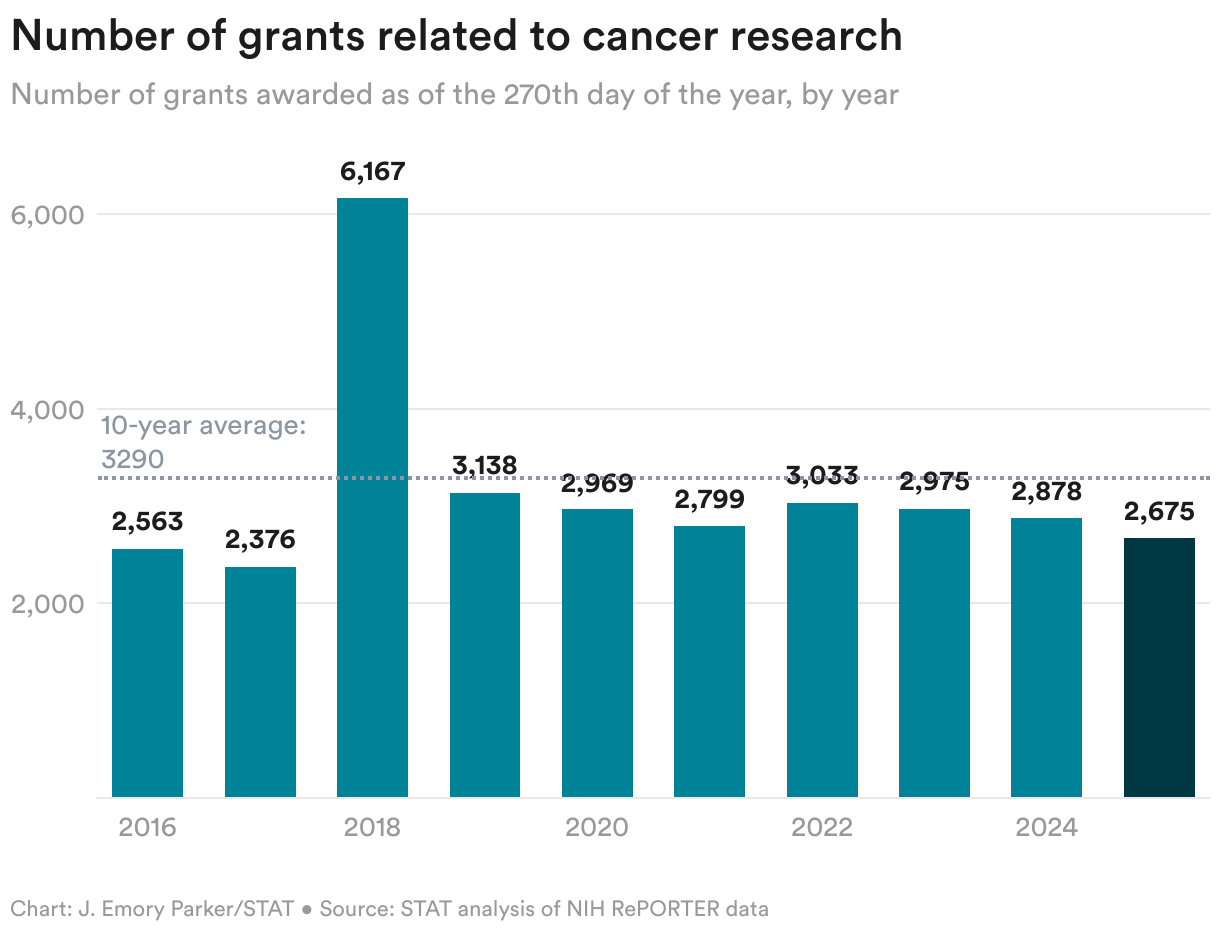
The shift cut across the agency’s $37 billion extramural portfolio, largely driven by a switch to paying for many multiyear grants entirely up front — which left money for fewer projects. The change affected vaccine research and work investigating health disparities — both targets of ire from the current administration. But it also has reduced the number of new studies looking into cancer, Alzheimer’s disease, and HIV/AIDS, all areas that generally have bipartisan support, according to STAT’s analysis of grants approved by scientific review panels for those disease areas.
There has also been a drop in high-risk, high-reward grants, which are intended to incentivize scientists to take big swings on creative ideas. Jay Bhattacharya, the current NIH director, previously studied the agency’s ability to fund novel ideas, and in his Senate confirmation hearing, he said his “plan is to ensure that the NIH invests in cutting-edge research in every field to make big advances rather than just small, incremental progress over years and sometimes decades.”
But grants in that vein, too, have seen cuts. In the first nine months of 2024, the NIH funded 406 high-risk, high-reward grants; in 2025, that fell to 364. In a response to STAT’s questions received after this story was published, NIH said, “The assertion that there is less high-risk, high-reward science taking place is incorrect. Innovative, groundbreaking research — driven by bold ideas and rigorous inquiry — is actively pursued across all 27 NIH institutes and centers.” It also attributed some cuts in research on HIV/AIDS, cancer, and Alzheimer’s to those projects’ inclusion of “DEI criteria that NIH determined limited the reach of research benefits.”

Even on campuses that weren’t directly targeted by the administration as alleged hotbeds of “woke” thinking or antisemitism, that didn’t lose hundreds of millions in grants overnight, the volatile funding climate has forced academic institutions into a defensive crouch — freezing hiring, laying off staff, and scaling back graduate training programs. After years of steady growth, enrollments in Ph.D. programs in the life and biomedical sciences flatlined in the fall of 2025, according to initial data from the National Student Clearinghouse Research Center.
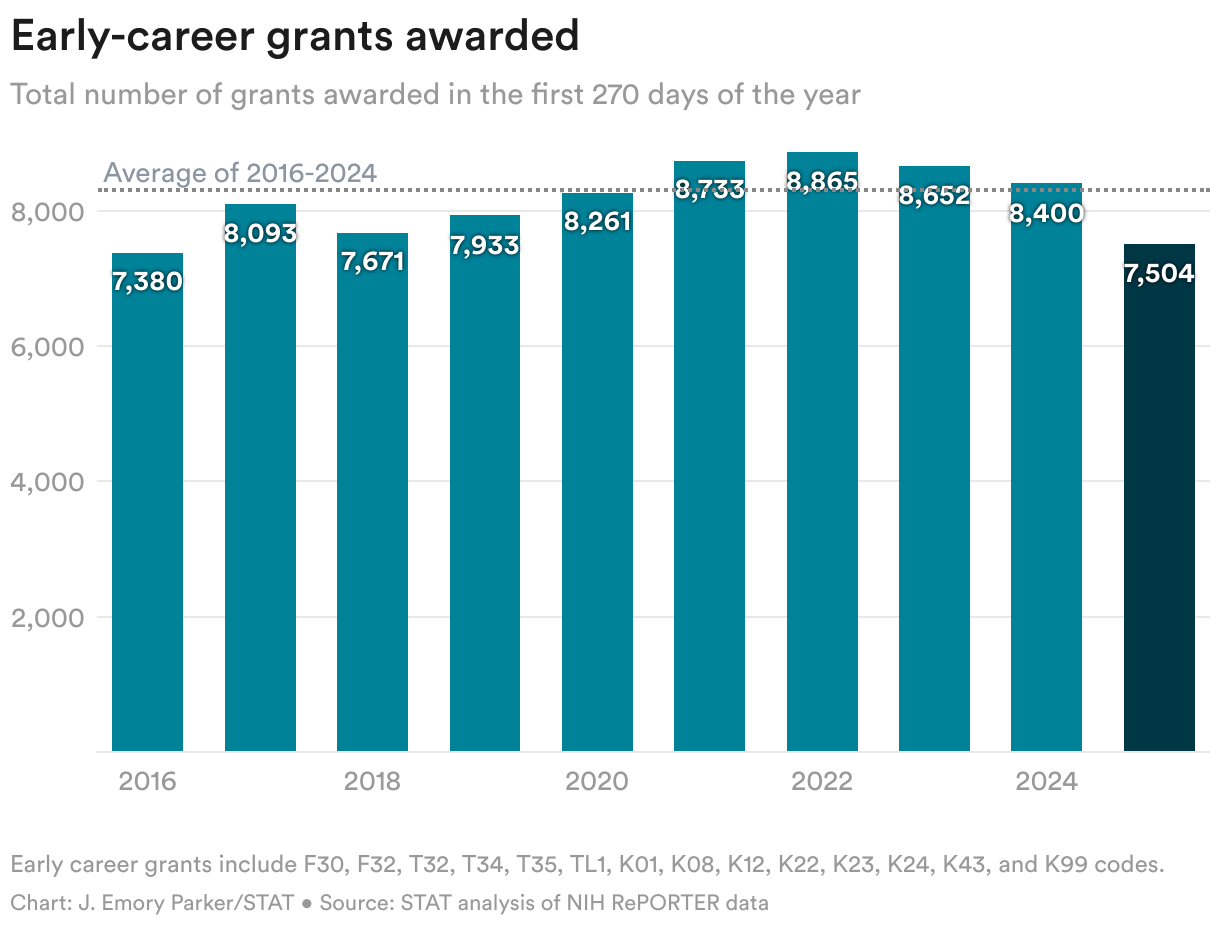
This came on top of another blow for trainees: The STAT analysis of NIH data shows that the number of early-career grant awards — given to graduate students and postdoctoral researchers — fell this year to its lowest point since 2016. NIH told STAT it “continues to track challenges that early-career investigators face and to implement programs that address barriers to advancement.”
Arguably the most insidious fallout is that many scientists who work at universities no longer feel they can count on the U.S. government as a reliable partner in the pursuit of research for the public good. “That’s the most devastating part of all this,” one NIH official told STAT. “Why would anyone trust the NIH ever again?”
“That social compact is being systematically undermined at the moment by a group of ideologues whose real target is not science; its real target is what they perceive to be the power and the arrogance of elite institutions, starting with the great research universities of this country,” said Shirley Tilghman, a molecular biologist and former president of Princeton — one of those universities. To onlookers like Tilghman, what has happened since January seems to be a tragedy of unintended consequences. “The intention was to punish elite universities, it was not to destroy the scientific capacity of the United States, but that’s what they’re doing,” she said. “It’s one thing to destroy something. It is quite another to destroy it and have nothing to replace it with. I think that’s the moment we’re in.”
But the men charged with leading the administration’s science policy paint a very different picture. They see this moment as an opportunity to bring about long-sought reforms to the infrastructure underlying how federal dollars are doled out to universities and their scientists. Outside of the administration, some scientific leaders see potential for the unprecedented shake-up to melt away the inertia that has stymied change at the federal science agencies.
To better understand this historic inflection point, STAT interviewed more than two dozen biomedical researchers, science policy experts, historians of science, and current and former federal health officials, including four former NIH directors. (Most spoke openly, but some requested anonymity to speak freely.) They expressed a range of views about how the administration’s actions have eroded the partnership of government and academia, what it means for the future of health and science in America, and what a recovery or a reimagining of the system might look like. The only thing they all agreed on is that there’s no going back.
“Whatever comes next is never going to be what it used to be,” said Larry Tabak, who served as the NIH’s principal deputy director from 2010 until he was pushed into early retirement in February. “The genie is out of the bottle.”


This article is exclusive to STAT+ subscribers
Unlock this article — plus in-depth analysis, newsletters, premium events, and news alerts.
Already have an account? Log in


