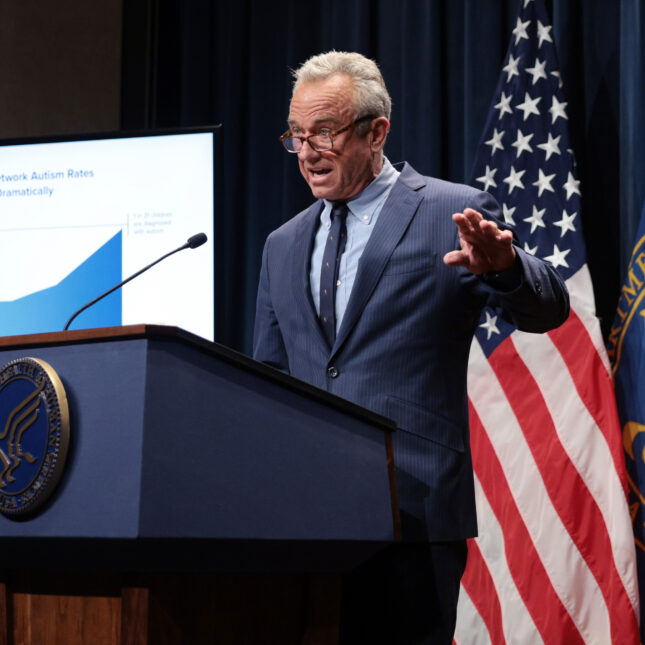

BETHESDA, Md. — The federal autism advisory committee met for the first time since Trump took office, months after health secretary Robert F. Kennedy Jr. fired most of the committee’s scientific experts and replaced them with activists and advocates who more closely align with his controversial views on the link between autism, vaccines, and environmental factors.
In its first meeting in 19 months, the Interagency Autism Coordinating Committee, which helps set the federal research agenda and the hundreds of millions that come with it, focused on how to help autistic people with the highest support needs. The group voted on Tuesday to recommend several proposals to help this population, including a directive that would change the existing scientific definition of people with “profound autism.”
Most of the substantive discussion during the meeting revolved around how to define profound autism, a diagnosis that applies to about a quarter of people on the autism spectrum. Some advocates and researchers have been eager to increase recognition for this population, which often requires around-the-clock care but has routinely been overlooked by much of the existing research.
In her introductory remarks at the National Institutes of Health, IACC chairman Sylvia Fogel set the tone, talking passionately about her autistic son who is minimally speaking and has complex support needs. “For those with the most complex needs, [there] is deep exhaustion and a constant, terrifying question: what will happen to their loved ones when they can no longer provide care?” said Fogel, a psychiatrist and Harvard Medical School instructor.
The committee also voted to urge the Department of Health and Human Services to implement coordinated safety measures to help protect autistic people who wander from their caregiver, and to encourage Medicaid to establish guidelines for diagnosis and possible health risks.
However, it’s unclear whether the committee’s proposals will have widespread impact.
The federal body has been shrouded in mystery and steeped in controversy since it was reformulated by Kennedy. Most of the group’s public members are new and haven’t served on the IACC before. Mainstream organizations that have long had a seat at the table — the Simons Foundation, Autism Speaks, the Autistic Self-Advocacy Network — are gone. In their place are organizations whose representatives spent the day advocating for more research into controversial topics like diet and facilitated communication, rather than established causes of autism like genetics. Several new members have views that align with Kennedy’s claim that childhood vaccines can cause autism, even though researchers have not found a credible link.
Given the widespread changes and the tumultuous year for the autism community, it’s unclear if Congress, federal health agencies, and private autism research organizations will listen to IACC’s guidance.
The turmoil is not over, either. Kennedy’s overhaul of the group and its unfamiliarity with some of the nitty-gritty of procedural requirements was evident throughout the afternoon. The group spent nearly an hour stumbling through the intricacies of federal law before taking votes on certain proposals against the wishes of several federal members. David Mandell said the procedural hiccups are indicative of the group’s broader failures to understand the existing scientific literature on autism as well as past meetings.
“They’ve ignored the rules that govern them and are pushing forward an agenda without any opportunity for public or even member input,” said Mandell, a longtime autism researcher and professor of psychiatry at the University of Pennsylvania. “There’s just so much wrong here.”
It’s difficult to determine precisely how many dollars IACC has directed in the past to profound autism research compared to other parts of autism research, but experts suggest that it is significantly less in comparison to things like genetic research or services for adults. The focus on this population is one of the few commonalities shared between IACC and the group of autism researchers and advocates who have formed a separate independent group to try and wield influence.
A focus on ‘profound autism’
Last Thursday, the committee published a memo with four proposals for the meeting’s discussion. In it, Fogel proposed to “adopt a federal research and policy designation for profound autism.”
The memo laid out a different definition for profound autism than a 2022 article in The Lancet, in which profound autism was defined to include people who were minimally speaking and had an IQ below 50. Fogel’s definition excluded intellectual disability in favor of focusing on functional limitations.
As members settled in for the committee meeting on Tuesday, the new proposed definition divided the room. Immediately after Fogel finished her presentation on the topic, hands shot up. Representatives from federal health agencies hesitated to back Fogel’s definition after only having a few days to consult with their colleagues at their respective agencies.
“I do have a concern that if we too narrowly define profound autism, we will end up excluding, unintentionally, a number of individuals from studies. So it can potentially backfire and have the opposite effect on our research portfolios,” said Andrea Beckel-Mitchener, part of the National Institutes of Mental Health and deputy director of the NIH BRAIN Initiative.
In the morning session, other members brought up proposals aimed at decreasing the risk of autistic people wandering out of safe areas and risking injury and increasing recognition about the role that co-occurring illnesses play with autistic people. Previous IACC meetings had tackled this topic, though there was no mention of how to build on that work, nor the genetics research or adult employment challenges that had been routine areas of discussion in prior years. There was also scant mention of vaccines.
The meeting was mostly a polite affair, free from some of the rancorous shouting in past IACC meetings.
But cracks spread after committee members returned from an afternoon break to vote on which proposals to submit to Kennedy. NIMH chief of staff Megan Kinnane said some federal members were wary about taking a vote on the proposals without having more time to discuss with their agency colleagues. In the past, members would have weeks, rather than days to review proposals.
The public members moved to vote anyway. “I think we’ve had ample time for deliberation in a public setting today, and all the members have had the materials since Thursday. And I think to imply that this is not compliant with [the Federal Advisory Committee Act] is not accurate. I, for one, reject that,” said Fogel.
Prior IACC members said that pushing for a vote after just a few hours of deliberation circumvented the public’s right to public information and violated the rules on transparency governing the committee.
“It’s astounding that the federal members were raising concerns that that vote could be illegal and the public members insisted on a vote anyway,” said Sam Crane, an autistic self-advocate and former public member of IACC.
The proposals sailed through, though many federal members abstained. The committee turned to its final business: establishing working groups to bring in experts to talk about topics, including communication and adult medical care for autistic people. The verbal jousting restarted as public members sought to take the reins of these working groups before federal members cut in to suggest that public members were boxing federal members out of any leadership position.
“I’m glad you’re here, but you’re not the leader on these topics. You’re just not,” said Ginger Taylor, a parent of an autistic kid and former director of the Maine Coalition for Vaccine Choice. “We have the experience and the knowledge. We have the kids who have recovered. We have the kids who have died. We’re the story.”