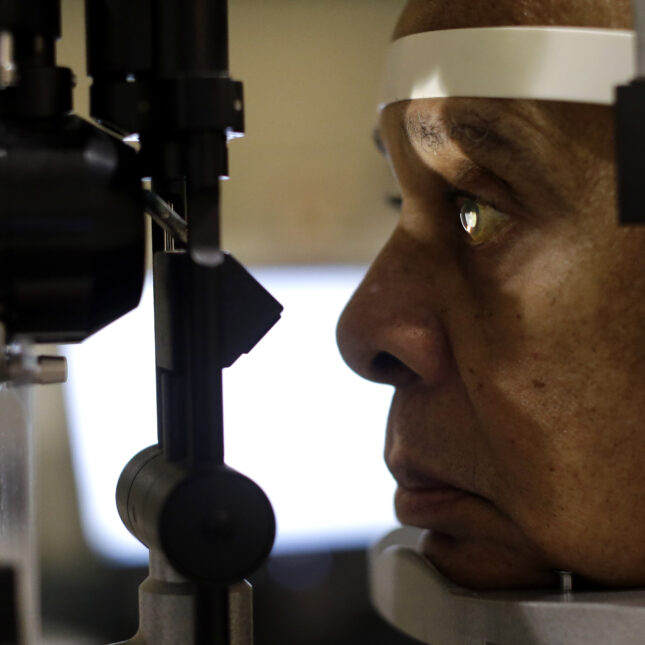

Glaucoma is the second-leading cause of blindness, and a silent one at that. It’s estimated that half of the patients who develop it are unaware of their condition, as they lose peripheral vision only when the disease is more advanced, and the damage is irreversible.
There isn’t a cure, and while medication can control hypertension in the eye to slow or stop further damage to the optical nerve, it has shortcomings.
The eye drops are dosed based on intraocular pressure (IOP) measurements taken in the doctor’s office, typically once every several months. This results in less-than-exact readings, because the pressure can change throughout the day, and even due to the body’s position or the stress level. Further, patients need to use the medication daily, and adherence declines as time passes.
A new smart lens, presented in a research article published Wednesday in Science Translational Medicine, could solve both issues, its authors say. Called a theranostic device because it combines therapeutic and diagnostic capabilities, it has the flexibility of a regular contact lens. It monitors ocular pressure without need for electronics or a battery, and delivers pulses of the drug as needed to control the pressure.
When there are changes in the eye’s internal pressure, the cornea shape changes, in turn modifying the shape of the contact lens and the volume of an embedded microfluidic chamber, triggering the drug’s release.
Much like regular contact lenses, the device would be tailored to the individual’s vision and eye, and the patient would have a couple of weeks to get used to the lens and report any discomfort. The lens would be changed weekly, with the possibility of longer wear depending on the ability to expand the drug-holding capacity.
Both the monitoring and drug delivery functions performed reliably when tested live in the eyes of rabbits — one group with ocular hypertension and a control group without — which are the animals whose eyesight is most similar to humans. The device was also tested on ex vivo cow eyes.
This isn’t the first attempt to make a smart contact lens for the purpose of real-time monitoring. In 2018, the Google spinoff Verily shelved its high-profile program to develop a glucose-sensing contact lens that would spare diabetes patients from needle sticks.
There has been more progress in the creation of wearable IOP monitoring lenses, but they are bulky, uncomfortable, or rely on electronic components. Triggerfish, a continuous ocular monitoring system made by Sensimed and approved by the Food and Drug Administration, is considered quite effective; it is meant to be worn for 24 hours to provide more extensive and accurate information on eye pressure.
“The Triggerfish product is amazing,” said Yangzhi Zhu, director of the Biomedical Device Center at the Terasaki Institute for Biomedical Innovation in California, “but for practical life, it has limitations.” Some of the device’s components, he said, “are rigid, nontransparent, and the mechanical mismatch between the soft cornea surface and the mechanical components integrated to those lenses can induce a lot of very significant ocular discomfort,” he said.
Zhu, who designed the overall project and experimental study, said his team was focused on a different approach. “We believe less is more. So we didn’t use any battery, we didn’t use any electronics. Everything is based on polymers,” he said, “so that means everything is soft, flexible.”
James Wolffsohn, a professor of optometry at Aston University in Birmingham, England, said this new device stood out compared to existing ones because of its comfort and size, as well as the potential of being much less expensive than current options.
Wolffsohn, who was not involved in the device development, was intrigued by the combination of real-time monitoring and drug release, which he thinks could address the adherence problem, but also by the drug-release mechanism in itself, which he said he could see used in other conditions, too. “This is generally quite clever,” he said.
He did have one point of concern when it comes to glaucoma treatment. “Quite often the medications are not fast acting,” he said. This means that if the pressure level was high enough to trigger release of the medication, it would take quite some time for it to have effect. “You may need to know the pattern” of a patient’s eye pressure, he said, and program the drug release accordingly. But the device’s real-time monitoring could be helpful for that, too, potentially doing a more sophisticated job than in-office measurements, especially for patients who already wear contact lenses, so they are used to the product.
“The next step is to work with our clinical partners to do a small human trial to confirm the practical use,” said Zhu, who, with the Terasaki Institute, applied for a patent for the pressure monitoring contact lens last year.
The path to eventual FDA approval could be complex, and it would move on separate paths at two speeds: The monitoring system would be quicker to get approval, but the drug dispensing system is subject to more rigorous regulatory standards and could take much longer. Still, the latter has the potential to have the most impact on the broader ophthalmology field and beyond, said Zhu.
“I would say this is a kind of open-source platform, and we can extend the technology to other disease applications including ocular, neurological, and systemic disease,” he said.