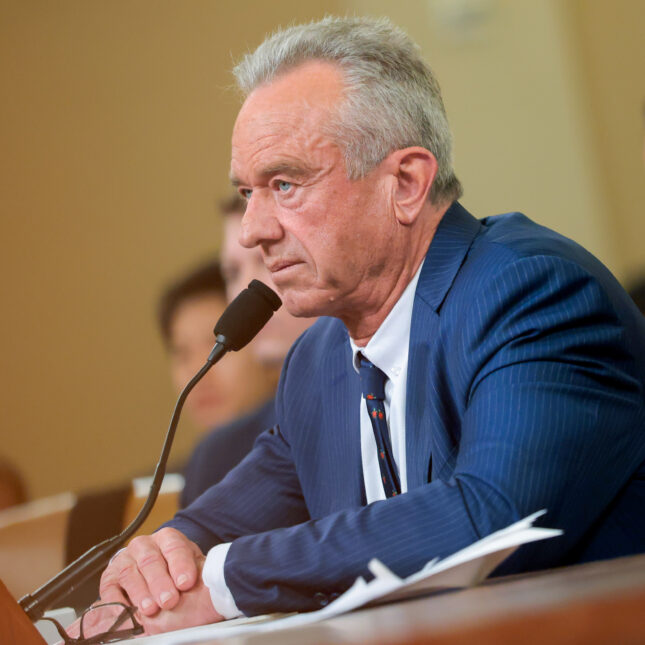
Our former colleagues in Congress recently heard from Health and Human Services Secretary Robert F. Kennedy Jr. for the first time in more than half a year.
Several congressional committees held hearings with Kennedy as they examined the Trump administration’s budget priorities. It was a key opportunity for lawmakers to build on the administration’s significant health policy achievements — and for the most part, they seized it. While Democrats were predictably critical of the secretary’s every move, Republicans wisely pushed back on the administration’s proposal to reduce funding for the National Institutes of Health. And with good reason. Sustained NIH funding underpins the research and development pipeline that makes vaccines possible at a time when voter polling shows Americans want leaders that support vaccine access.
Congress deserves credit for asking tough, necessary questions. But the job isn’t finished. As Kennedy returns to his work, lawmakers must stay engaged — not merely to applaud or criticize the administration, but to actively address the policy challenges that will determine whether America’s public health safeguards remain stable and secure.
Consider the systems we use to track and forecast disease outbreaks. More than a year since measles reemerged nationally, outbreaks are still catching many local public health departments off guard. In places like Florida and Utah, state health reporting has lagged behind real-time transmission or omitted key details — leaving residents without a fully up-to-date picture of outbreaks. South Carolina and Texas know the consequences all too well. If our systems are straining to track a familiar disease with relatively strong baseline immunity, that raises serious questions about readiness for emerging disease threats.
During the hearings, Kennedy expressed confidence in America’s ability to defend against outbreaks, but he and Congress did not discuss the specifics of disease surveillance. Policymakers must explore in more detail how to strengthen state-level reporting infrastructure to keep future threats at bay.
Another critical question is the integrity of the vaccine advisory framework, which is in an unprecedented state of flux. Since last spring, HHS has replaced every member of the CDC’s top vaccine advisory committee, which it continues to restructure. It also reversed several long-standing vaccine recommendations, overriding the consensus of leading infectious disease experts without obvious new clinical evidence.
Last month, a federal court called the committee’s actions “arbitrary and capricious” and paused its operations entirely. The instability has left no functioning vehicle to issue the guidance that physicians, insurers, and parents depend on how to make sound vaccination decisions.
On the Hill, Kennedy affirmed that the measles vaccine is safe and effective. Congress must now ensure that federal policy continues to treat vaccines as the vital public health safeguard they are — and that public messaging is clear, consistent, and capable of rebuilding trust.
These concerns feed directly into questions of access and choice. According to recent polling, 9 in 10 Americans believe in the importance of vaccines. But more than half fear that politicization and confusion are undermining vaccine access.
Moreover, many Americans who want to get vaccinated can’t do so because of physical and regulatory access barriers. Insurance coverage restrictions, providers’ financial constraints, and difficult transportation logistics hinder vaccine access for many patients, especially rural Americans and less mobile seniors.
Congress should work to bolster vaccine access — from health coverage and reimbursement to physical distribution — and ensure federal messaging helps equip Americans to make informed vaccination choices.
Lawmakers must also examine how the government can best support vaccine innovation. President Trump’s Operation Warp Speed, which produced the first Covid-19 vaccines using mRNA technology, exemplified how federal support can spur breakthroughs. Since Operation Warp Speed’s success, federal policymakers have continued to help scientists explore mRNA’s potential to combat other diseases, from flu to hepatitis. Yet HHS decided recently to halt funding for mRNA vaccine development, which could keep these next-generation medicines from ever coming to fruition.
During the hearings, Kennedy highlighted a recent $1 billion investment in vaccine research. But lawmakers did not press him on restoring support for key areas like mRNA. They should ensure that promising research is not sidelined and that America remains at the forefront of vaccine innovation.
Infectious diseases affect every American. Policymakers across parties and branches of government have a duty to work together to strengthen the nation’s vaccine infrastructure and avoid leaving Americans vulnerable to public health crises that could carry immense human and economic costs.
Kennedy will bear much of the public responsibility for the direction of America’s vaccine system. But Congress shares that responsibility. Patients are counting on lawmakers to maintain oversight, promote stability, and work collaboratively to ensure access to vaccines — and the freedom to make informed choices — is preserved.
Larry Bucshon, M.D., practiced as a cardiothoracic surgeon for nearly two decades before representing Indiana’s 8th Congressional District as a Republican from 2011 to 2025. Michael C. Burgess, M.D., represented Texas’s 26th Congressional District as a Republican from 2003-2025 and previously practiced as a doctor of obstetrics and gynecology for more than 20 years.