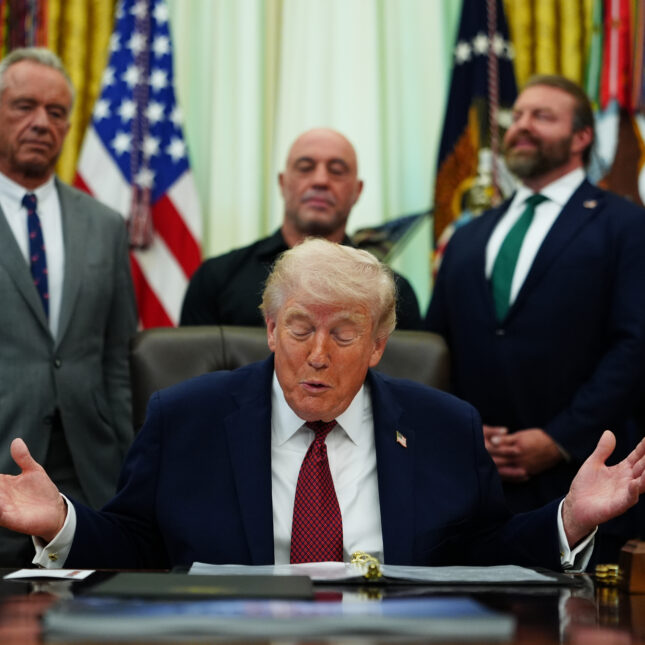
I have spent the last 10 years of my life investigating psychedelics as novel treatments for mental health conditions. When President Trump signed his executive order on psychedelic medicines, my first thought was: He got this one right. My second thought: My field may not be ready for it.
The order itself is sweeping. It directs the Food and Drug Administration to issue priority review vouchers to accelerate approval timelines, expands right-to-try pathways for ibogaine, dedicates $50 million in ARPA-H funding to psychedelic research, authorizes the Drug Enforcement Administration to speed scheduling of FDA-approved psychedelics, and launches collaboration with Veterans Affairs on therapies for veterans.
Any one of these orders would have been remarkable five years ago. In quick succession, the FDA issued priority review vouchers to Compass and Usona for their psilocybin programs and to Otsuka for methylone, and it cleared DemeRx’s noribogaine to begin the first U.S. clinical trial of an ibogaine derivative.
In the wake of this tidal wave, some of my colleagues have raised concerns about the politicization of science. The American Psychiatric Association, responding to the executive order, called for an evidence-driven approach and warned that the science does not yet support psychedelic use outside of approved clinical trials. This concern is fair, but the executive order does not lower the FDA’s proof bar. It changes whether the political and institutional will exists to generate the proof, and that will has been the binding constraint for years.
Our regulatory system was never apolitical. It defaults to “no” when the cost of “no” falls on patients rather than bureaucrats. The FDA rejected MDMA for PTSD in 2024, and tens of thousands of Americans were left without a seemingly effective treatment many of them desperately wanted. Suicide is the second leading cause of death among Americans ages 10 to 24. An estimated 17 veterans take their own lives every day. Caution, held long enough, becomes its own form of negligence.
The defense of the executive order, though, is the easy part. The harder question is whether my field is prepared to do what comes next.
For years, psychedelic researchers have expressed dismay, and rightly so, about Schedule I barriers, scarce funding, and a glacial regulatory process. Promising trials of psilocybin for alcohol use disorder, tobacco use disorder, and cocaine use disorder each took the better part of a decade to complete. These barriers are now coming down. The opening is here, and we have to take advantage of it.
The FDA’s rejection of Lykos Therapeutics’ MDMA for PTSD application in 2024 is an instructive failure. I would have preferred to see the application approved, but the problems the advisory committee flagged were real, including functional unblinding, unstandardized psychotherapy protocols, and concerns about the durability of treatment effects. Lykos’ defenders, including MAPS founder Rick Doblin, countered that the agency had moved the goalposts because formal guidance on psychedelic trial design only arrived in 2023, after Lykos’ Phase 3 studies were already complete. This complaint is fair, but it doesn’t change what was wrong with the trials. Now that the guidance is on the books, the field has no excuse for not following it.
There is a notable “know-do gap” in psychedelic-assisted therapy — the distance between what trials suggest is possible and what the health care system is built to deliver. Closing this gap will be the work of the next decade, and it will demand researchers, clinicians, regulators, and policymakers willing to grind through complex logistics and correct course as they learn.
Start with the workforce, where the field is divided. Therapy-intensive protocols, like the MDMA work behind the Lykos application or Compass’ and Usona’s psilocybin programs, assume hours of preparatory and integration sessions with two trained clinicians in the room during dosing.
If these models prevail, tens of thousands of new psychedelic therapists will need to be trained over the next decade, a number we will not approach without serious rethinking of training pipelines, supervision, and reimbursement.
Other sponsors are betting differently. Definium’s MM120 for generalized anxiety disorder and Otsuka’s methylone for PTSD are pursuing drug-only or minimal-psychotherapy designs that look more like conventional pharmacology. Even these protocols still need trained personnel to safely monitor a six-to-eight-hour psychedelic experience, so the workforce question shifts rather than disappears.
Either way, reimbursement cannot wait. Billing CPT codes, reimbursement pathways, and payer education take years to build, and if we defer that work until after approval, only those patients who can pay cash will benefit at first.
Then there is the question of who gets included. The lack of ethnoracial diversity in psychedelic trials has been well documented. The socioeconomic picture is at least as bad, and it receives less attention. These trials demand significant time commitments that are practically out of reach for those with multiple competing demands and limited reliable transportation. The patients carrying the heaviest burden of substance use and mental illness are too often the ones we recruit last, if at all.
Vulnerable populations belong at the center of this work. The ARPA-H funding mechanism, which requires matching state investment, offers some leverage here as federal dollars could be prioritized for state proposals that put underserved populations in primary cohorts rather than secondary ones.
Some of this work is already underway, particularly for veterans. The VA recently funded its first study of psychedelic-assisted therapy since the 1960s, evaluating MDMA for PTSD and alcohol use disorder, and a bipartisan bill in Congress would designate at least five VA medical facilities as innovative therapies centers of excellence. Where these treatments get delivered, by whom, and with what oversight is downstream of approval, but it has to be solved in parallel.
Of the order’s targets, ibogaine has gotten the loudest coverage, and the political coalition behind it — which includes veterans groups, podcaster Joe Rogan, and the Texas program — has shaped that emphasis more than the underlying science has. A recent letter in the Washington Post argued that compounds further along on safety and efficacy, like MDMA for PTSD and psilocybin for depression, deserve comparable attention. The order’s ibogaine spotlight cannot be allowed to pull resources and attention from those programs. We have to advance all of them, even when the political moment is calling for one.
Ibogaine will also draw the loudest pushback because it carries serious cardiac risks, including documented deaths from QTc prolongation. The temptation will be to keep it at arm’s length and let the conversation move on. But demand for ibogaine has never been higher. Americans are already seeking it, either underground domestically or, more often, abroad in settings with very little oversight. The right-to-try expansion in the executive order at least gives some of these patients a legal pathway for ibogaine access. Texas launched a $50 million public-private ibogaine program last year that built inpatient settings, cardiac monitoring, and emergency protocols into its study design from the start. The NIH funded ibogaine research briefly in the 1990s and abandoned the work over cardiotoxicity. Thirty years later, we are still circling the same problem. The executive order forces us to engage with it rather than repeat the same concerns from the sidelines.
The road ahead will not be smooth. Rescheduling FDA-approved psychedelics through the DEA is a complicated legal and scientific undertaking. Preventing psychedelics from becoming luxury medicine for the wealthy will take deliberate work. Esketamine already costs as much as $45,000 per year and stands as a cautionary tale of “approved but inaccessible.” Commercial pressures will test the integrity of the field, and some companies will fail that test.
But none of this justifies standing still. My field has spent a decade pointing to Schedule I, scarce funding, and regulatory inertia as the reasons our progress has been so slow, and those complaints are now being taken seriously at the highest levels of government. If we cannot respond with rigorous trials, equitable access, real-world safety data on ibogaine, and a workforce ready to deliver these treatments at scale, the next decade will look much like the last one — except this time we won’t have excuses.
Peter S. Hendricks, Ph.D., is university professor of psychiatry and behavioral neurobiology and consults for several entities in the psychedelic industry. The views expressed in this article are solely those of the author in their personal capacity.