


The MOSAIC program is the type of early-career research grant that checks many of the boxes of the Trump administration.
National Institutes of Health Director Jay Bhattacharya listed “training future biomedical scientists” as one of his top priorities, and has spoken often about the need to support researchers at the start of their careers, when they tend to do their most original work. MOSAIC is meant to do just that, funding scholars during the precarious transition from postdoctoral researchers under the wings of more established scientists to independent lab heads.
Dispersing federal research funding, largely concentrated at private universities on the coasts, to the rest of the country is another NIH goal, and scientists supported by transition awards have a track record of migrating away from the coasts, and from private institutions to public ones.
But none of that mattered. Over the first several months of the administration, the MOSAIC program was terminated because it was seen as running afoul of President Trump’s executive order to eliminate diversity, equity, and inclusion (DEI) initiatives. It was one of several awards that the NIH had created to diversify its grant recipients, targeting a point in the training pipeline where academia often loses people underrepresented in the field. It was offered to scientists from a broad range of disadvantaged backgrounds, defined more broadly than just race and ethnicity.
Many of the MOSAIC scholars felt betrayed, because they had been urged to seek funding through the program when they could have qualified for other training grants not focused on diversity. Now they’re scrambling for other jobs, or to set up their new labs with limited resources.
“I think everyone has their own horror story,” said Luis Rodriguez, a 44-year-old molecular biologist who began his lab at George Washington University this year and was counting on his now-canceled MOSAIC grant to jumpstart his research on the cellular processes underlying lung disease.
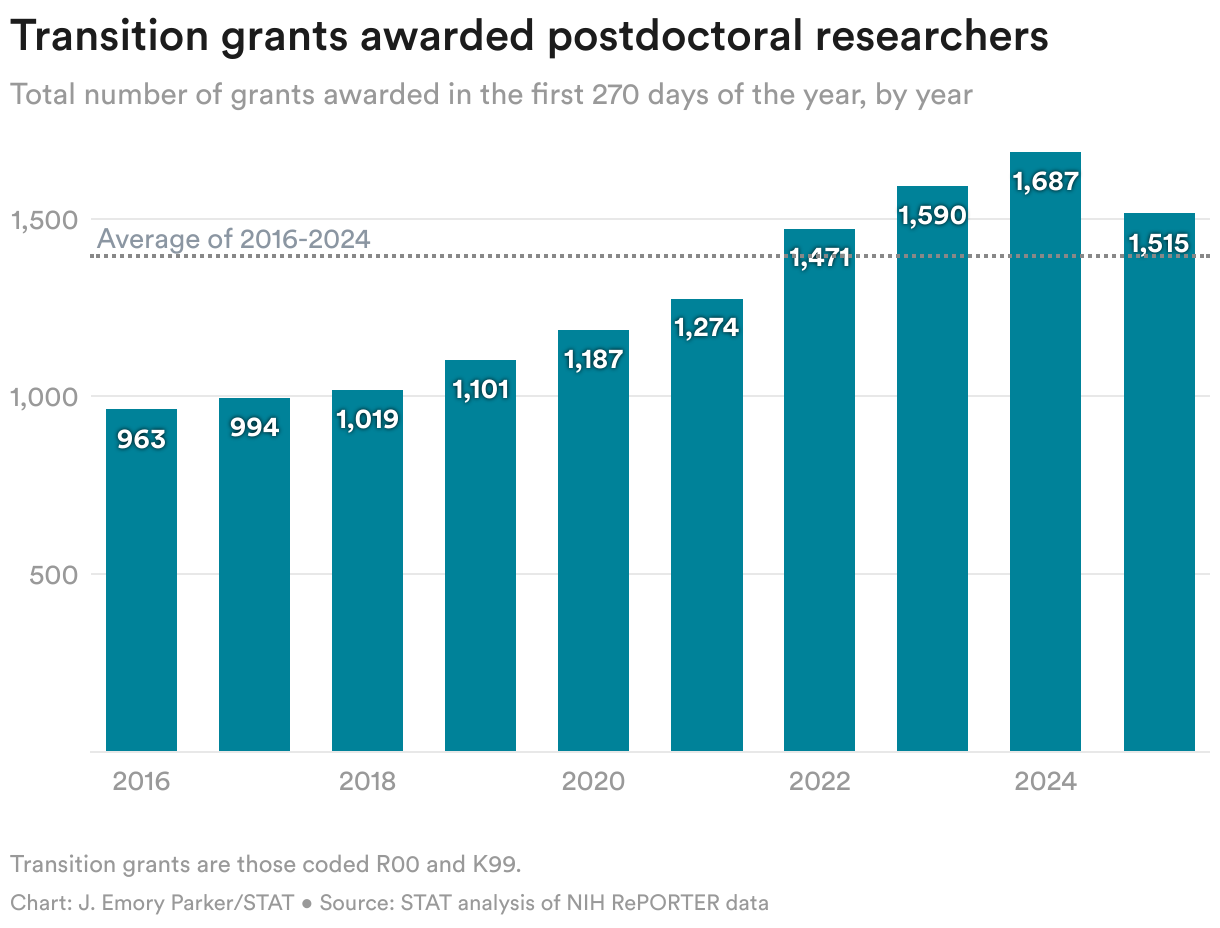
Early-career scientists like him have been pummeled by the administration’s various cuts. All told, 104 researchers saw their MOSAIC funding terminated, according to Grant Witness, an independent project tracking NIH grant terminations, although some have had their grants restored for now under a court order. In addition, a STAT analysis of NIH data shows that the agency awarded new transition grants to 172 fewer postdoctoral researchers in the nine months before the government shutdown than in the same period the previous year — a 10% reduction.
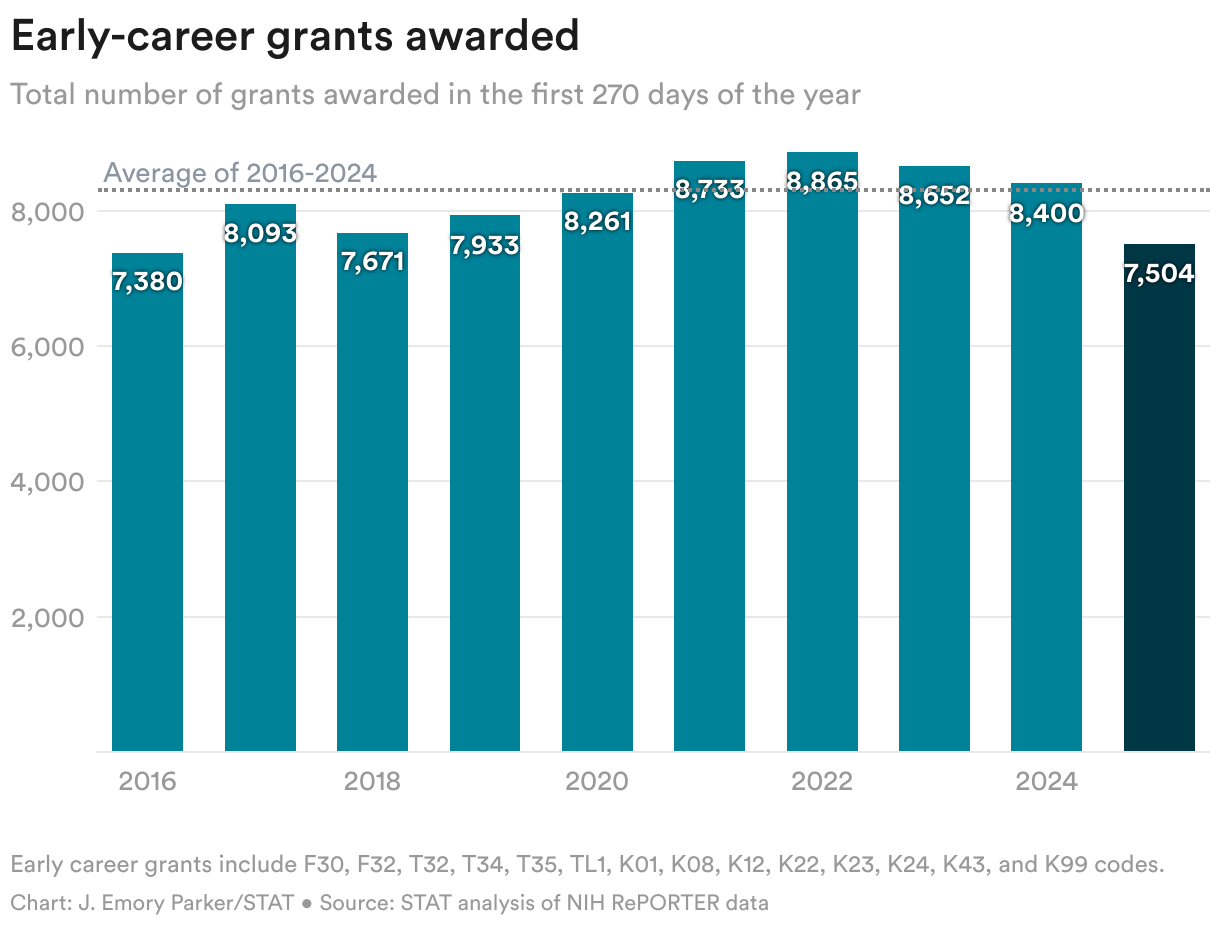
Looking more broadly, the NIH funded 896 fewer new early-career grants of any type compared to the same period last year for undergraduates, Ph.D. students, and postdocs. The 7,504 early-career researchers receiving awards from January through September was fewer than in any similar period since 2016.
Asked about the MOSAIC program’s elimination and STAT’s findings, the NIH said it is “shifting its portfolio to maximize the impact of federal taxpayer dollars and ensure proper oversight of this funding in support of gold-standard science rather than politicized DEI ideology. Bhattacharya has stated the national need for, and the agency’s commitment to, supporting career continuity for all early-career researchers. NIH continues to implement programs and other initiatives that address early-career barriers to career progression.”
The drop-off in support for early-career researchers could endanger the already-tenuous pipeline that fuels the country’s scientific workforce, according to officials who have studied the scientific career path.
“I do worry a lot about early-career scientists and people who are in their training, or thinking about going into science because the interest is shifting and shifting in the wrong direction, and I don’t think that’s good for the country,” said Tara Schwetz, who was an NIH deputy director until March, and was a co-chair of a working group to reimagine the way the agency supports postdocs.
In the early weeks of the administration, Schwetz’s office would receive spreadsheets of grants to terminate. The first letter of an NIH grant’s project number denotes the kind of award it is, with “F” and “T” awards dedicated to training grants. “Every time I saw an F or a T, my heart just broke. These are early-career people,” Schwetz said. “This might be their one source of financial support.”
Rodriguez, the GW molecular biologist, studies which kinds of cells are involved when lungs become so damaged they need to be replaced by transplant, which is becoming more common as the population ages. For years, the only treatments that were available for idiopathic pulmonary fibrosis (IPF), the main focus of his work, targeted cells called fibroblasts, which connect organs together. With the advent of technologies that could better target and study individual cells, Rodriguez and others have been trying to find new treatment avenues.
“We’ve identified that there are other populations, nonfibroblast populations, that are critical to the disease process,” he said. “I would say that IPF specifically is a really great example of 10 years of failed clinical trials followed by the newest ideas driving us away from the approaches and strategies we used in the past to develop new drugs and new therapeutics that hopefully will have the potential to help patients.”
But he’s had to dial back the ambitions for his lab. Rodriguez received an offer to become an assistant professor at George Washington University in February, before his $160,000 award — and the potential of hundreds of thousands more over the next four years — was terminated in June. He has a startup fund, which some universities offer new faculty to incentivize them joining their ranks, to fall back on, but it only goes so far.
“I’ve had to trim back a lot of my hiring, and I’ve also had to trim back a lot of the overarching goals,” he said in an interview from his mostly empty lab. He had intended to hire two postdocs and two lab techs, but has been able to bring on just one technician and is in the process of hiring one postdoc. He also had to put off buying a time-lapse fluorescent microscope, used to image organoids. He is using colleagues’ equipment instead— but that comes with time constraints that can further stall projects.

‘It’s a good cross-section of America’
MOSAIC, an abbreviation for Maximizing Opportunities for Scientific and Academic Independent Careers, was created to solve two problems the NIH was grappling with: the lack of diversity among investigators with NIH funding, and the low pay and poor career prospects of postdoctoral researchers. The grant is split into two phases — the first provides up to $125,000 a year for two years of postdoctoral research, and the second supports three years of research as a tenure-track professor, with up to $249,000 a year.
The need for such a program was obvious to Michael Sesma, who helped set it up when he was a program officer at the NIH. He remembers being one of few researchers of color in his undergraduate training, his Ph.D. program, and at the beginning of his career as a professor.
“We tried to put the money where it would do the most good and help the most people,” said Sesma, who retired from the agency in December 2024. The program was largely successful in helping postdoctoral researchers transition into early-career faculty. While Sesma began the program at one of the NIH’s 27 institutes, it was adopted by another 23. Programs like MOSAIC were important, he said, because of deeply entrenched biases in academia. Researchers from marginalized backgrounds may be written off before they have a chance. Similarly, he feels that MOSAIC didn’t get a fair shake from the administration.
“The biggest problem is there’s been no real analysis of what these programs were about. They’ve just been labeled,” he said, and labeled incorrectly. “There’s a perception that they’re not based on merit. There’s this perception that people who participate in those programs wouldn’t be competitive in the mainstream, that they’re not as smart, they’re not as creative, or innovative or whatever, and they’re leapfrogging people.”
While opponents of diversity programs characterize them as themselves discriminatory, the MOSAIC program’s definition of diversity was broad. It included people who grew up in rural areas, those who had parents who did not complete bachelor’s degrees, those who were in the foster care system, or those who were recipients of various federal aid programs. (The NIH’s Interest in Diversity statement, which outlines these requirements, has been removed by the Trump administration, but can be accessed through the Internet Archive). The MOSAIC program also required applicants to demonstrate they are engaged in outreach to their community — which is not a requirement of a traditional transition award.
“It’s a good cross section of America, more so than most programs. So when those grants were being terminated, because these were perceived as DEI-related, I was deeply concerned that this was just completely ill-informed and unjust,” said Jeremy Berg, who formerly led the institute that created the MOSAIC program.
While it was still relatively young, an analysis Berg did of NIH data indicated the program was accomplishing its goals of bringing marginalized researchers into academia. He found that the percentage of grantees that successfully transitioned from their postdoc award to a professorship award was similar for recipients of transition awards that explicitly mention diversity and those that don’t.
Bhattacharya has repeatedly stated one goal of his tenure is to empower young researchers. His own research when he was at Stanford University found that researchers are the most innovative early in their careers. That same study found that the agency’s ability to fund novel research — what he called “edge science” — has declined over time. To fix this, he has called for the NIH to hold a mirror up to itself and scientifically evaluate the success of its various programs.
But the Trump administration’s broad brush approach to eliminating grant programs provided no opportunity for careful review, said Donna Ginther, a University of Kansas labor economist who has studied the scientific workforce.
“We could be doing better as a country in how we make those scientific decisions. At the same time, a lot of these programs were chucked out the door, and that creates disruption for scientists, students, and postdocs. It creates collateral damage for our youngest, early-career scientists, and I think that is a problem,” said Ginther, who co-authored a seminal study that forced the NIH to reckon with the lack of diversity among those who receive funding. Even Bhattacharya has held up her work as a prime example of what he would like to see done.
Ginther suspects programs like MOSAIC, and similar transition awards, are beneficial because research has shown that the faster a scientist can start an independent lab, the more successful they are likely to be. While it is too early to tell what the long-term effects of the administration’s actions might be, Ginther predicts that because of changes to funding, and to immigration policies, “the scale of science being produced will shrink.”
Sarah Vick, a postdoctoral researcher at the Fred Hutchinson Cancer Center and a former MOSAIC scholar, has felt that shrinkage. Vick, who is 40, was in the postdoc portion of her award, expecting funding for another year when she thought she could publish work and enter the job market. But university searches for faculty have become even more competitive than they normally are, she said. Some schools postponed job searches in the last cycle because of uncertainty around funding cuts. And now there are postdocs like her who lost funding and are on the job market earlier than they anticipated. Vick has applied to 17 universities and gotten one virtual interview.
It hasn’t helped that Vick studies the immune responses of cells in the vaginal tract to infections like HIV, with the goal of developing better vaccines — and that the administration has targeted grants for both women’s health and vaccines. In some grant applications, she has changed “women” to “XX participants,” to avoid having grants be flagged by political appointees. But not having NIH funding makes her a less appealing job candidate.
“I was awarded the [MOSAIC] grant,” she said. “They can’t take that away. But now I have no money to bring with me.”

More worry, more stress
The MOSAIC program was scrubbed from the NIH website earlier this year, a signal that the program’s future was precarious, and termination letters began rolling out shortly after.
A federal judge soon ruled that the NIH cuts were tantamount to discrimination, even though the plaintiffs did not make that argument in court, but the decision didn’t apply to all MOSAIC scholars. Only researchers at public universities in states that sued, or members of a handful of professional organizations that joined in the case, had their grants reinstated. (Neither Rodriguez nor Vick were covered by the ruling.) While the Supreme Court later overturned the federal district judge, NIH took no further action.
The original decision resonated with MOSAIC scholars like Rodriguez, who felt that their program had been targeted, though they met the same criteria as researchers who received non-diversity transition awards. “The only reason I don’t have this funding is because my last name is Rodriguez,” he said. “It has nothing to do with the science.”
Added Amelia Cuarenta, a behavioral neuroscientist who was supported by the MOSAIC program, “It is disheartening that there were so many of us that were ushered into this program that were eligible for other ones.” Her research, investigating how the environment can change genes in brain cells, would have been eligible for other transition awards that were not diversity-focused, and had she received one of those, she feels she would have kept her funding.
Rodriguez, Vick, and Cuarenta all said their determination to stay within academia and the sciences hasn’t faltered, even with the Trump administration’s disruptions. But they fear that having been a part of this program could have negative reverberations later in their careers. As he opens up his lab, slimmer than expected, Rodriguez expects he may struggle to gather the data he needs to apply for awards down the line, which may in turn hurt his ability to keep his lab open and eventually get tenure.
“I definitely worry more and have more stress. The potential for failure is far more realistic than it’s ever been,” he said. “I had a lot of optimism and hope and a plan. We plan for years in advance, because we have to. When a wrench gets thrown into that plan. It’s like, ‘Adapt, adjust, and keep moving.’ But certainly now the optimism is harder to maintain.”
Grant data analysis methodology
For this analysis, STAT downloaded 747,395 grant records for the past 10 years from the NIH RePORTER database. Grant data were joined with 2021 American Community Survey Census data for location analysis. Grants were grouped by year and filtered by day of the year in order to compare partial 2025 data with previous years. A cut-off of the 270th day of the year was used to avoid complications related to the government shutdown at the end of 2025. For each year, the sum of grant award dollars and the sum of the number of awards was calculated. All analyses were performed using R with Tidyverse packages.
To analyze grants by topic area, they were filtered by searching for relevant terms in the name field for study sections, the scientific panels that review applications. For HIV/AIDS-related grants, a list of study section codes was obtained from the NIH website and used to filter grants. Only years for which relevant grants were found in the database were included in each topic area analysis. High-risk, high-reward grants were identified by filtering for grants with codes DP1, DP2, and DP5. Early career grants were identified by filtering for grants with codes F30, F32, T32, T34, T35, TL1, K01, K08, K12, K22, K23, K24, K43, K99, and R00. Transition grants were identified by filtering for grants with codes R00 and K99.
STAT’s coverage of health inequities is supported by a grant from the Commonwealth Fund. Our financial supporters are not involved in any decisions about our journalism.


