Theresa Gaffney is the lead Morning Rounds writer and reports on health care, new research, and public policy, with a particular interest in mental health, gender-affirming care, and LGBTQ+ patient communities. You can reach Theresa on Signal at theresagaff.97.
Get your daily dose of health and medicine every weekday with STAT’s free newsletter Morning Rounds. Sign up here.
Good morning, we made it to Thursday. Thanks for reading.
Advertisement
Who benefits from discount telehealth visits?
Drugmakers have long used coupons to lower the out-of-pocket costs patients pay for expensive medications. And now, as links between pharmaceutical companies and telehealth providers grow, coupons are also cutting down the cost of consulting with a clinician who can prescribe a product.
But experts warn that a discount for a telehealth appointment — whether obtained directly from a drug company or perhaps your favorite chatty podcast — can lead patients down a very different road than a visit with a clinician who has no ties to a particular drug company or pharmaceutical product. “It seems like you’re getting a bargain,” said researcher Steven Woloshin. “But you’re taking your eye off the prize.”
Read more from Katie on the ethical questions surrounding these coupon codes. This is the fourth installment of her series investigating how telehealth is driving the consumerization of drugs. If you haven’t already, read parts one, two, and three too.
Advertisement
Across 7 hearings, RFK Jr. talks a new, more moderate MAHA
Health secretary Robert F. Kennedy Jr. once claimed there are no vaccines that are safe and effective. Yesterday, when a senator asked him if he supports people getting vaccinated, Kennedy had a different answer: “Yes.” While the HHS leader had already toned down his rhetoric on vaccines since being nominated to run the agency, there’s been an even larger shift of late. (In a new First Opinion essay, two lawyers challenging Kennedy’s changes to ACIP say his shift is politically motivated and won’t last.)
It’s not just about vaccines. STAT’s Daniel Payne and Chelsea Cirruzzo recapped Kennedy’s week of hearings and found more changes in the Trump administration’s health messaging. Read more.
More calls to 988, fewer suicides among young people
After the U.S. launched 988, a shortened phone number for the national suicide and crisis hotline, suicide deaths among adolescents and young adults dropped 11% compared to projected rates, according to a new JAMA study. I wrote yesterday about the data, as well as the lingering questions about the lifeline’s long-term funding and the Trump administration’s decision last year to remove the “press three” option for LGBTQ+ young people. Read more.
Racial inequities persist in maternal mortality
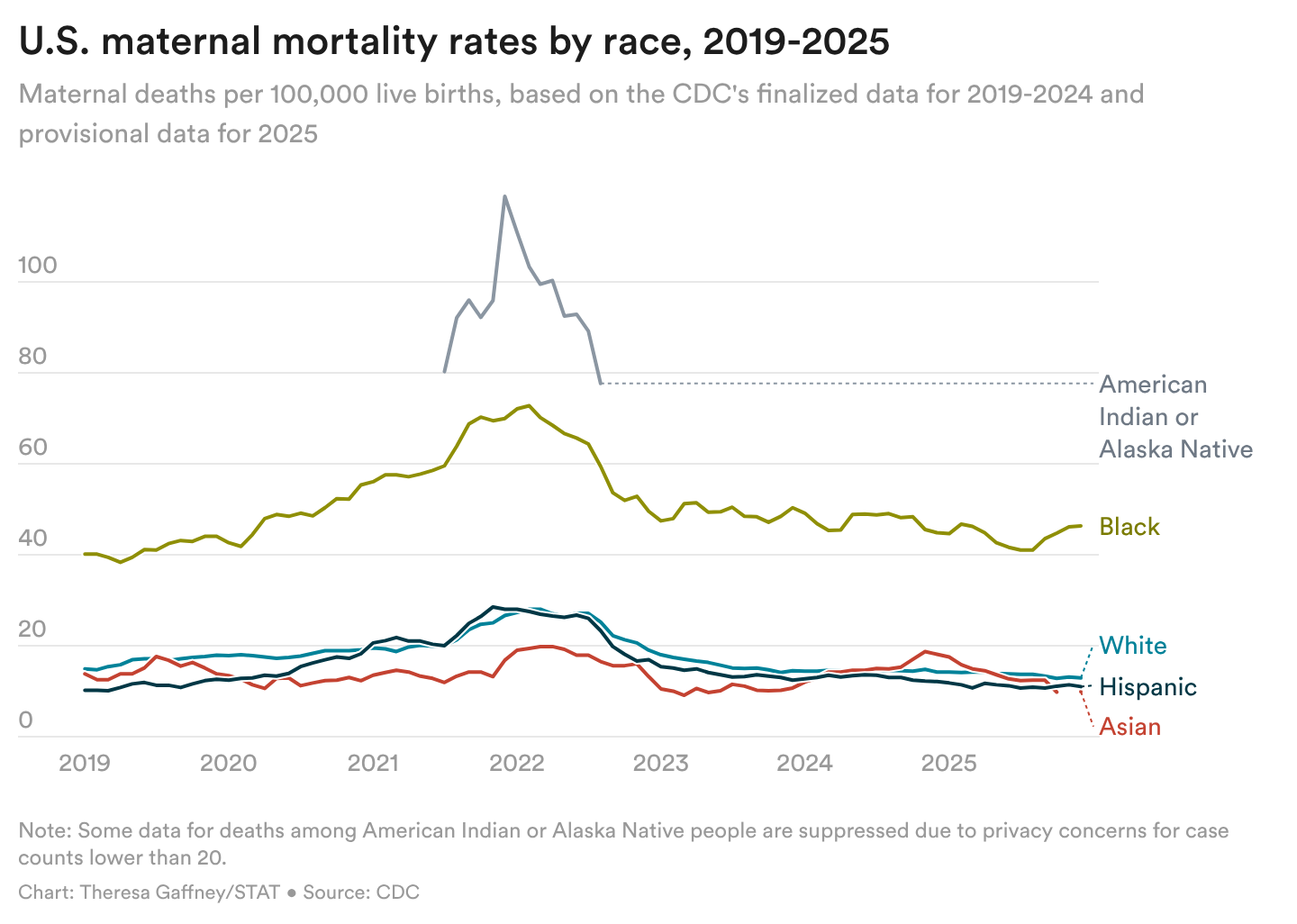
The CDC recently released these updated visualizations of the latest maternal mortality data, and I wanted to share this one with you here. STAT has reported many times over the years on the persistent racial inequities in the U.S. maternal health care system. The data are important to keep in mind amid political pressure from the Trump administration targeting DEI initiatives. Under that pressure, a major medical school accreditor recently dropped requirements to teach health equity, and Harvard Medical School removed a reference to diversity and inclusion from its mission statement.
‘Impressive’ new data on gene therapy for deafness
In a clinical trial with the largest cohort to date — 42 participants across eight sites in China, ranging from babies to a 32-year-old — researchers found that 90% of participants reported significant improvement in their hearing after receiving a gene therapy injection.
Advertisement
“We’re still only within the first 10 years since the [first FDA-approved] gene therapy drug, so I don’t think we really know what the very long term is gonna look like,” said otolaryngologist Jenna Devare, who was not associated with the study. “But I think this study is really impressive.” Read more on the growing scientific consensus and the latest research.
What we’re reading
CDC won’t publish report showing Covid shots cut likelihood of hospital visits, Washington Post
Theresa Gaffney is the lead Morning Rounds writer and reports on health care, new research, and public policy, with a particular interest in mental health, gender-affirming care, and LGBTQ+ patient communities. You can reach Theresa on Signal at theresagaff.97.
Newsletter
Understand how science, health policy, and medicine shape the world every day